Dry Lubricant Coatings On Low Displacement Pistons:
An inferior or poorly applied dry-film lubricant coating
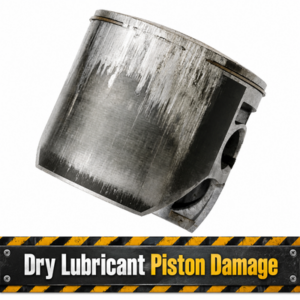
An inferior or poorly applied dry-film lubricant coating on a small-displacement motorcycle piston can create problems, particularly on a high-RPM, high-specific-output engine. The important point is that the coating is a secondary friction/scuffing protection system—it does not replace engine oil.
What can happen if the coating is poor?
A properly engineered piston-skirt coating is intended to reduce friction, scuffing and adhesive wear between the piston skirt and cylinder wall. Some coating systems can also provide additional protection during conditions where the normal oil film is temporarily less effective.
If the coating is poorly bonded, incorrectly formulated, inadequately cured, applied outside its intended thickness range, or applied to an improperly prepared piston surface, several potential issues can arise:
- Coating can wear through prematurely
- Piston-to-cylinder friction can increase
- Aluminum transfer onto the cylinder wall may occur
- Skirt scuffing can develop
- Localized heat and loading can increase
- Effective skirt surface condition can change as the coating wears
- In severe conditions, piston seizure can occur.
Piston/cylinder scuffing is associated with increasing friction and temperature and, if sufficiently severe, can progress to seizure.
Why it can matter even more on a small 110–125cc engine
A small piston doesn’t automatically mean a low-stress piston.
For example, a small motorcycle engine may have:
High RPM + relatively high cylinder pressure + lightweight/short piston skirt + high piston acceleration
That combination can produce significant skirt loading despite the piston being physically small.
The coating can be particularly useful during conditions where the oil film is less effective, such as cold starts, high load, high temperature or transient operating conditions. Piston-skirt coatings are used in some applications to reduce friction and wear under these conditions.
The quality of the coating matters
A good dry-film system isn’t simply “black paint on the piston.”
The substrate preparation, coating chemistry, thickness, curing/bonding process and surface texture all matter. For example, some established dry-film piston-skirt coating systems specify coating thickness in the approximate 12–37 micron range while also requiring appropriate surface preparation for adhesion. The appropriate specification depends on the particular coating system and application.
There are also different generations and formulations of piston coatings. Some are engineered for greater wear resistance and oil retention in addition to providing friction-reduction characteristics.
A poor-quality, incorrectly specified or poorly bonded skirt coating can reduce the intended margin of protection and may contribute to increased skirt wear, friction and scuffing—particularly when the engine is operated under high RPM and load.
Once a coating begins to wear or fail, the underlying piston/cylinder interface becomes increasingly dependent on the conventional oil film. Adequate lubrication remains essential for controlling piston-skirt friction, wear and scuffing.
Wild Boar Pistons are precision cast and are designed for the intended application without relying on a dry-film skirt lubricant coating.
Wild Boar’s approach is to develop the piston skirt, profile, clearances and piston/cylinder combination as part of the overall piston design rather than relying on a separate dry-film skirt coating as a primary design feature.
Technical Information & Comparison Disclaimer
This article is provided for general technical and educational information. Piston coatings, coating thicknesses, piston materials, skirt profiles, clearances and operating conditions can vary between individual engines, components and applications. Any measurements, observations or comparisons presented are based on the products, specifications and information available to APB Auto at the time of publication.
References to piston coatings or third-party products are made for identification and technical comparison purposes only. The comparison is intended to explain differences in coating use and piston design approach and is not intended to suggest that another manufacturer’s product is defective, unsafe or unsuitable for its intended application.
Engine modifications should be assessed as a complete system, and appropriate dimensions, clearances, lubrication requirements and component suitability should be independently verified before assembly or operation. Controlled dimensional and durability testing is recommended where performance or high-RPM operation is involved.



Piston Skirt Length On Small Displacement Pistons
Piston Skirt Length On Small Displacement Pistons
Particularly important for a small-displacement/high-RPM engine
A short skirt isn’t automatically a design fault. A manufacturer can deliberately use a shorter skirt to reduce reciprocating mass and friction. The important question is whether the skirt geometry, piston profile, clearance and cylinder/bore design provide adequate stability under the engine’s actual RPM and load conditions.
Our Wild Boar piston skirt is designed and optimized around the intended application, with performance, longevity and reliability under high RPM as key design priorities.
Potential considerations with a shorter piston skirt
To Concise: A shorter piston skirt can reduce the available guiding surface and potentially increase piston rocking and localized skirt/cylinder-wall loading. Whether this becomes a problem depends on the piston geometry, skirt profile, piston-to-cylinder clearance, operating RPM/load and lubrication. Controlled dimensional and durability testing is required to establish the actual effect.
Our Wild Boar piston skirt is designed around the intended application, with performance, reliability and longevity under high RPM as key priorities.
The important engineering point is that the difference isn’t simply cosmetic:
Why the shorter skirt matters
The skirt is one of the surfaces that guides the piston in the cylinder. Reducing its length can reduce the amount of piston-to-cylinder guidance available.
That can potentially increase:
One particularly important observation
The piston-pin position matters enormously here.
A useful comparison isn’t simply:
It is:
That’s because the piston is effectively being guided around the pin axis. A shorter skirt can provide less leverage against rocking, depending on the complete piston and cylinder geometry.
Technical Information & Comparison Disclaimer
This article is provided for general technical and educational information. Piston geometry, skirt length, clearances, bore dimensions and operating conditions can vary between individual engines, components and applications. Any measurements, observations or comparisons presented are based on the products, specifications and information available to APB Auto at the time of publication.
References to third-party products or designs are made for identification and technical comparison purposes only. The comparison is intended to explain differences in piston geometry and engineering approach and is not intended to suggest that another manufacturer’s product is defective, unsafe or unsuitable for its intended application.
Engine modifications should be assessed as a complete system, and appropriate dimensions, clearances and component suitability should be independently verified before assembly or operation. Controlled dimensional and durability testing is recommended where performance or high-RPM operation is involved.
Related Useful Links –
Double Thickness Head / Base Gaskets On A Small Displacement Engine
Dry Lubricant Coatings On Low Displacement Pistons
Dry Lubricant Coatings On Low Displacement Pistons:
An inferior or poorly applied dry-film lubricant coating
An inferior or poorly applied dry-film lubricant coating on a small-displacement motorcycle piston can create problems, particularly on a high-RPM, high-specific-output engine. The important point is that the coating is a secondary friction/scuffing protection system—it does not replace engine oil.
What can happen if the coating is poor?
A properly engineered piston-skirt coating is intended to reduce friction, scuffing and adhesive wear between the piston skirt and cylinder wall. Some coating systems can also provide additional protection during conditions where the normal oil film is temporarily less effective.
If the coating is poorly bonded, incorrectly formulated, inadequately cured, applied outside its intended thickness range, or applied to an improperly prepared piston surface, several potential issues can arise:
Piston/cylinder scuffing is associated with increasing friction and temperature and, if sufficiently severe, can progress to seizure.
Why it can matter even more on a small 110–125cc engine
A small piston doesn’t automatically mean a low-stress piston.
For example, a small motorcycle engine may have:
High RPM + relatively high cylinder pressure + lightweight/short piston skirt + high piston acceleration
That combination can produce significant skirt loading despite the piston being physically small.
The coating can be particularly useful during conditions where the oil film is less effective, such as cold starts, high load, high temperature or transient operating conditions. Piston-skirt coatings are used in some applications to reduce friction and wear under these conditions.
The quality of the coating matters
A good dry-film system isn’t simply “black paint on the piston.”
The substrate preparation, coating chemistry, thickness, curing/bonding process and surface texture all matter. For example, some established dry-film piston-skirt coating systems specify coating thickness in the approximate 12–37 micron range while also requiring appropriate surface preparation for adhesion. The appropriate specification depends on the particular coating system and application.
There are also different generations and formulations of piston coatings. Some are engineered for greater wear resistance and oil retention in addition to providing friction-reduction characteristics.
Once a coating begins to wear or fail, the underlying piston/cylinder interface becomes increasingly dependent on the conventional oil film. Adequate lubrication remains essential for controlling piston-skirt friction, wear and scuffing.
Wild Boar Pistons are precision cast and are designed for the intended application without relying on a dry-film skirt lubricant coating.
Wild Boar’s approach is to develop the piston skirt, profile, clearances and piston/cylinder combination as part of the overall piston design rather than relying on a separate dry-film skirt coating as a primary design feature.
Technical Information & Comparison Disclaimer
This article is provided for general technical and educational information. Piston coatings, coating thicknesses, piston materials, skirt profiles, clearances and operating conditions can vary between individual engines, components and applications. Any measurements, observations or comparisons presented are based on the products, specifications and information available to APB Auto at the time of publication.
References to piston coatings or third-party products are made for identification and technical comparison purposes only. The comparison is intended to explain differences in coating use and piston design approach and is not intended to suggest that another manufacturer’s product is defective, unsafe or unsuitable for its intended application.
Engine modifications should be assessed as a complete system, and appropriate dimensions, clearances, lubrication requirements and component suitability should be independently verified before assembly or operation. Controlled dimensional and durability testing is recommended where performance or high-RPM operation is involved.
Honda Navi Big Bore Piston Cylinder Kit
WOLRD”S FIRST NAVI ALLOY RACING KIT
LATEST NEWS: THE FIRST HONDA NAVI BIG BORE ALLOY RACING KIT
A New Era of Honda Navi Performance — Australian Designed & Developed
For years, Australian Honda Navi enthusiasts looking for more performance have had limited options. Traditional big bore conversions relied on modifying existing components, including a modified existing 53mm piston which used thicker gaskets to accommodate the setup, and modifying the original heavy cast-iron cylinder to complete the conversion.
Wild Boar Racing set out to take a different approach.
Introducing the World’s First Wild Boar Racing Honda Navi 125cc Big Bore Piston & Alloy Cylinder Kit — an Australian-designed and developed performance upgrade created as a complete, standalone kit, rather than a collection of modified standard components.
Built for Performance. Designed for the Navi.
The original Honda Navi cylinder is a heavy cast-iron component designed primarily around everyday economy and practicality. Wild Boar Racing takes a different direction, combining a lightweight alloy racing cylinder with a precision-cast, high-compression high rpm piston to create a performance-focused foundation for the Honda Navi.
The result is a 125cc kit designed to reduce engine component weight while delivering increased power and torque, even when fitted to an otherwise standard Honda Navi.
Performance Without the Expensive Build
One of the biggest advantages of the Wild Boar approach is simplicity.
You don’t need to start with an expensive camshaft upgrade or commit to a long list of additional modifications just to establish a stronger performance foundation.
The Wild Boar 125cc Big Bore Kit provides a purpose-designed starting point for riders who want more from their Navi — whether you’re looking for a straightforward performance upgrade or planning a more extensive build in the future.
Developed and trialed here in Australia, the kit brings together the key components in one purpose-built package.
Why Choose Wild Boar Racing?
The Wild Boar Difference
This isn’t simply about fitting a larger piston into a modified standard cylinder. It’s about taking a purpose-built approach to Honda Navi performance.
Wild Boar Racing was developed around a clear objective: to give Navi enthusiasts a dedicated reliable lightweight alloy cylinder and high-compression piston upgrade without making an expensive list of additional modifications the starting point.
Australian designed. Performance focused. Built around the Honda Navi.
If you’re ready to explore what your Honda Navi can do beyond standard, discover the Wild Boar Racing 125cc Big Bore Piston & Alloy Cylinder Kit at APB Auto.
Experience the Wild Boar Difference.