
Dry Lubricant Coatings On Low Displacement Pistons
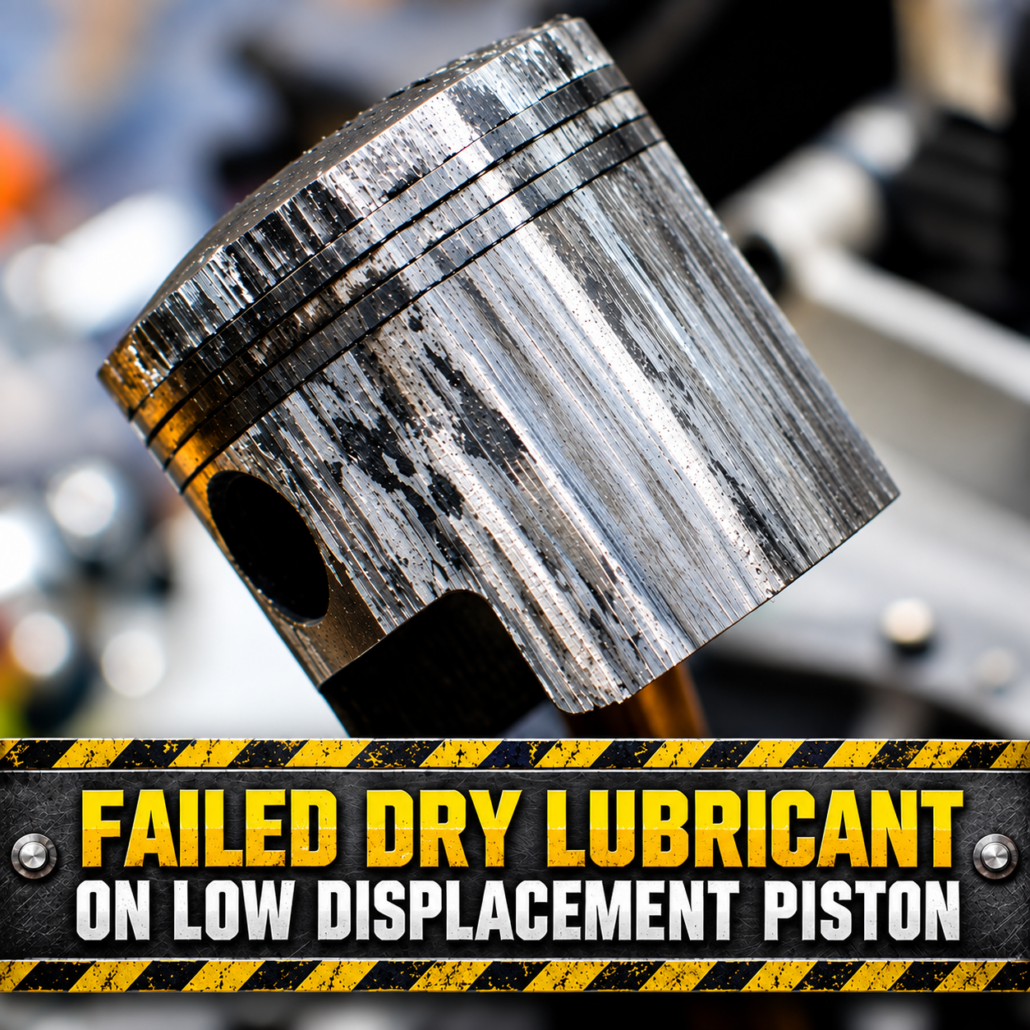
Dry Lubricant Coatings On Low Displacement Pistons:
An inferior or poorly applied dry-film lubricant coating
An inferior or poorly applied dry-film lubricant coating on a small-displacement motorcycle piston can create problems, particularly on a high-RPM, high-specific-output engine. The important point is that the coating is a secondary friction/scuffing protection system—it does not replace engine oil.
What can happen if the coating is poor?
A properly engineered piston-skirt coating is intended to reduce friction, scuffing and adhesive wear between the piston skirt and cylinder wall. Some coating systems can also provide additional protection during conditions where the normal oil film is temporarily less effective.
If the coating is poorly bonded, incorrectly formulated, inadequately cured, applied outside its intended thickness range, or applied to an improperly prepared piston surface, several potential issues can arise:
- Coating can wear through prematurely
- Piston-to-cylinder friction can increase
- Aluminum transfer onto the cylinder wall may occur
- Skirt scuffing can develop
- Localized heat and loading can increase
- Effective skirt surface condition can change as the coating wears
- In severe conditions, piston seizure can occur.
Piston/cylinder scuffing is associated with increasing friction and temperature and, if sufficiently severe, can progress to seizure.
Why it can matter even more on a small 110–125cc engine
A small piston doesn’t automatically mean a low-stress piston.
For example, a small motorcycle engine may have:
High RPM + relatively high cylinder pressure + lightweight/short piston skirt + high piston acceleration
That combination can produce significant skirt loading despite the piston being physically small.
The coating can be particularly useful during conditions where the oil film is less effective, such as cold starts, high load, high temperature or transient operating conditions. Piston-skirt coatings are used in some applications to reduce friction and wear under these conditions.
The quality of the coating matters
A good dry-film system isn’t simply “black paint on the piston.”
The substrate preparation, coating chemistry, thickness, curing/bonding process and surface texture all matter. For example, some established dry-film piston-skirt coating systems specify coating thickness in the approximate 12–37 micron range while also requiring appropriate surface preparation for adhesion. The appropriate specification depends on the particular coating system and application.
There are also different generations and formulations of piston coatings. Some are engineered for greater wear resistance and oil retention in addition to providing friction-reduction characteristics.
A poor-quality, incorrectly specified or poorly bonded skirt coating can reduce the intended margin of protection and may contribute to increased skirt wear, friction and scuffing—particularly when the engine is operated under high RPM and load.
Once a coating begins to wear or fail, the underlying piston/cylinder interface becomes increasingly dependent on the conventional oil film. Adequate lubrication remains essential for controlling piston-skirt friction, wear and scuffing.
Wild Boar Pistons are precision cast and are designed for the intended application without relying on a dry-film skirt lubricant coating.
Wild Boar’s approach is to develop the piston skirt, profile, clearances and piston/cylinder combination as part of the overall piston design rather than relying on a separate dry-film skirt coating as a primary design feature.
Technical Information & Comparison Disclaimer
This article is provided for general technical and educational information. Piston coatings, coating thicknesses, piston materials, skirt profiles, clearances and operating conditions can vary between individual engines, components and applications. Any measurements, observations or comparisons presented are based on the products, specifications and information available to APB Auto at the time of publication.
References to piston coatings or third-party products are made for identification and technical comparison purposes only. The comparison is intended to explain differences in coating use and piston design approach and is not intended to suggest that another manufacturer’s product is defective, unsafe or unsuitable for its intended application.
Engine modifications should be assessed as a complete system, and appropriate dimensions, clearances, lubrication requirements and component suitability should be independently verified before assembly or operation. Controlled dimensional and durability testing is recommended where performance or high-RPM operation is involved.


Leave a Reply
Want to join the discussion?Feel free to contribute!