
HONDA NAVI 125CC BIG BORE KIT — A DIFFERENT APPROACH
EARLIER AFTERMARKET SOLUTIONS
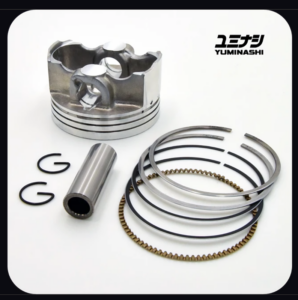
The Yuminashi 53mm piston was an aftermarket solution for increasing Honda Navi displacement. The piston set was supplied with the piston, rings, wrist pin and circlips, with the original Navi 50mm cast-iron cylinder bored to accept the larger piston.
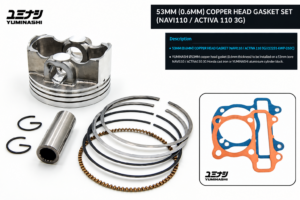
The 53mm conversion also used additional extra thick gasket components to establish the required installation geometry.
WILD BOAR 125CC BIG BORE RELEASE
Yuminashi subsequently developed a 54mm aluminum big-bore configuration for the Navi/Activa platform. Its later Performance Series configuration introduced additional features including a dry-film piston-skirt coating, DLC-coated piston pin and aluminum cylinder assembly.
Product specifications can change over time, so the comparison below distinguishes between the 53mm and 54mm Yuminashi configurations rather than treating them as the same product.
Yuminashi Next Generation 130cc — Product Listing
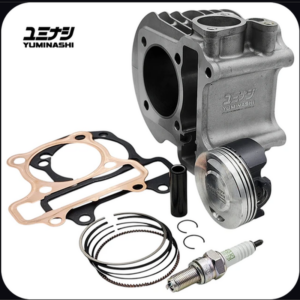
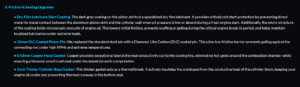
FEATURES DESCRIBED FOR THE LATER 54MM PERFORMANCE CONFIGURATION
- Dry Film Lubricant Skirt Coating: A dry-film coating is used on the piston skirt. Such coatings are intended to reduce friction and provide a protective surface during conditions where oil film lubrication is limited.
- 12mm DLC-Coated Piston Pin: The later Performance Series configuration uses a DLC-coated piston pin as a low-friction surface treatment.
- Additional Gasket Configuration: The later 54mm configuration uses additional extra thick gaskets as part of its installation and compression-ratio setup.
WILD BOAR VS YUMINASHI — BASE AND HEAD GASKET APPROACH
One of the key differences in the two approaches is how the piston, cylinder and installation geometry are packaged.
Wild Boar uses the OEM Honda Navi gasket thickness as the basis for its 125cc purpose-designed piston-and-cylinder package, rather than relying on substantially thicker gasket dimensions to establish the basic package geometry.
Standard Honda Navi gaskets may be used as replacement components where technically appropriate, subject to correct installation, measurement and clearance checks.
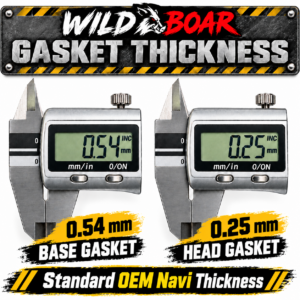
Yuminashi — Thicker Base / Head gasket configuration varies by product version
WHY GASKET THICKNESS MATTERS
A gasket is not simply a thermal-insulation spacer. Changing gasket thickness changes engine geometry and therefore needs to be considered as part of the complete engine design.
- Head-gasket thickness changes combustion-chamber volume and piston-to-head/squish clearance.
- Base-gasket thickness changes cylinder position and piston deck height.
- Changing cylinder height can alter the relationship between the piston, cylinder, head and cam timing.
- Additional sealing interfaces can introduce additional potential leak paths.
- On a small-displacement engine, fractions of a millimeter can represent a meaningful geometric change.
Using additional head or base gasket thickness can make a particular combination physically fit, but the resulting compression ratio, squish clearance, deck height, piston-to-valve clearance and cam timing should be deliberately recalculated.
DOUBLE HEAD GASKET
- Increases head-to-cylinder distance.
- Increases combustion-chamber volume.
- Reduces compression ratio.
- Increases piston-to-head/squish clearance.
- Changes the combustion geometry.
DOUBLE BASE GASKET
- Raises the cylinder relative to the crankcase.
- Changes piston deck height at TDC.
- Changes the relationship between cylinder and crankshaft.
- Can alter cam timing because the cylinder/head assembly moves relative to the crankshaft.
- Changes the relationship between piston, cylinder, cam chain and head.
WHY THIS MATTERS ON A NAVI
The Honda Navi is a relatively small-displacement engine, so fractions of a millimeter can have a measurable effect on installation geometry.
For example, adding another 0.25mm head gasket does not simply provide “0.25mm of insulation”. It also increases clearance volume and changes piston-to-head/squish geometry.
Likewise, adding approximately 0.54mm at the cylinder base represents a meaningful geometric change on a small-displacement engine.
If both base and head gasket thickness are increased to make a big-bore conversion fit, several dimensions change at the same time:
CYLINDER HEIGHT ↑ → DECK GEOMETRY CHANGES → CAM RELATIONSHIP CHANGES → HEAD CLEARANCE CHANGES → COMPRESSION CHANGES → SQUISH CHANGES
This is why gasket thickness should be treated as an engineered geometry parameter rather than simply an insulation solution.
WHY NGK CPR7EA-9 MAKES SENSE FOR THE WILD BOAR 125
The Wild Boar configuration changes several characteristics compared with the original Honda Navi configuration:
- 109cc → approximately 125cc
- 53mm piston
- Higher-compression piston crown
- Different combustion-chamber geometry
- Different combustion and cylinder-pressure conditions
These changes make spark-plug selection, spark location, clearance and combustion stability important considerations.
The Wild Boar 125cc kit includes an NGK CPR7EA-9 selected for the modified 125cc configuration.
NGK Heat Range 7 • 0.9mm Gap • 10mm Thread • 19mm Reach • Projected Insulator • Resistor Type
The Wild Boar configuration therefore uses a CPR-series projected-insulator plug while retaining NGK heat range 7.
Different engine configuration → different plug selection → same NGK heat range → projected-insulator CPR design.
Important: Spark-plug selection must always be confirmed against the final piston crown, combustion-chamber geometry and piston-to-plug clearance of the actual engine configuration.
WILD BOAR vs YUMINASHI PISTON DESIGN
We chose these two aftermarket examples to compare side-by-side and demonstrate a different Wild Boar approach.
LOOK BEYOND THE BORE. LOOK AT THE PISTON.
When increasing Honda Navi displacement, it is easy to focus on one number:
53mm.
But bore diameter is only one part of piston design.
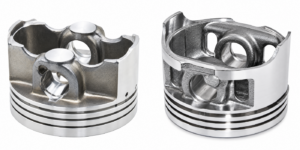
Piston skirt geometry, wrist-pin support, internal structure, compression height, crown design, ring lands, cylinder configuration, piston-to-cylinder clearance and installation geometry all contribute to the complete piston-and-cylinder package.
That is why Wild Boar took a different approach when developing its Honda Navi 125cc Alloy Racing Kit.
“What 53mm piston will fit the Navi?”
Wild Boar instead approached the design from the complete package:
“What should a purpose-designed 53mm piston and cylinder package look like when developed specifically around the Honda Navi?”
WILD BOAR vs YUMINASHI
A CLOSER LOOK AT TWO DIFFERENT PISTON DESIGNS
When the two pistons are placed side-by-side, differences in their visible structure and material distribution can be examined.
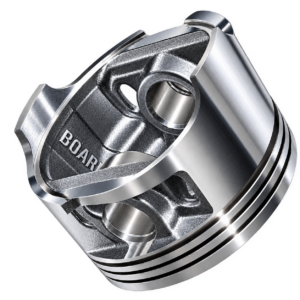
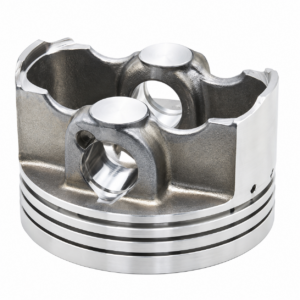
LOOK CLOSELY AT:
- Piston skirt structure
- Wrist-pin boss support
- Internal reinforcing structure
- Skirt openings and relief areas
- Retained material around the lower skirt
- Skirt length
- Crown design
- Overall piston geometry
- Material distribution
This comparison focuses on features that can be visually examined or measured.
It is not intended to claim that the Yuminashi piston will automatically fail, nor does appearance alone establish which piston has greater ultimate strength.
The purpose is to allow Navi owners to examine the physical differences and understand that the two products take different approaches to piston design.
WILD BOAR
53MM PRECISION-CAST PERFORMANCE PISTON
Purpose Designed • Precision Cast • Developed Around the Honda Navi
YUMINASHI
53MM / 54MM PISTON CONFIGURATIONS
Alternative 53mm / 54mm Bore-Up Approaches
The two products take visibly different approaches to piston structure and material distribution.
And that is where the comparison becomes interesting.
1. PISTON SKIRT STRUCTURE
One of the most noticeable differences is the way material is retained within the piston skirt.
The Yuminashi piston shown in our comparison has a more relieved and open internal configuration.
The Wild Boar piston shown in our comparison retains a more substantial visible skirt structure, including material around the wrist-pin region and lower skirt.
This comparison is not intended to suggest that more material automatically means a stronger piston. Instead, it highlights the different approaches to skirt support, material distribution and piston-cylinder interface.
The piston skirt contributes to piston support and control within the cylinder, particularly as operating speed increases.
DON’T JUST LOOK AT THE BORE.
Look at where the material is.
Look at where it has been relieved.
Look at the complete skirt.
2. WRIST-PIN BOSS STRUCTURE
The wrist-pin area is a critical load-transfer region of a piston.
Combustion and reciprocating forces are transferred through the piston, wrist pin and connecting rod.
The two piston designs visibly use different arrangements of surrounding material around the wrist-pin bosses.
YUMINASHI
The Yuminashi piston shown in the comparison has a more relieved/open visible configuration.
WILD BOAR
The Wild Boar piston retains more visible surrounding structure around the wrist-pin bosses and connecting areas.
This visual difference does not, by itself, prove a difference in ultimate strength.
It does demonstrate that the two piston designs use different approaches to material distribution and internal structure.
3. INTERNAL PISTON STRUCTURE
Turn the pistons over and another difference becomes apparent.
The internal webs, ribs, skirt openings and connecting structures are not identical.
The Wild Boar piston retains substantial visible structure connecting the wrist-pin region with the surrounding skirt.
The Yuminashi piston shown in the comparison uses a more relieved/open configuration.
WHY DOES THIS MATTER?
A piston is much more than a circular piece of aluminum with a larger diameter.
The complete design includes:
- Crown
- Ring lands
- Compression height
- Wrist-pin bosses
- Internal webs
- Skirt profile
- Skirt length
- Material distribution
- Piston mass
- Cylinder relationship
Changing one area can influence the requirements of another.
That is why Wild Boar developed the piston and cylinder as a combined package.
4. PISTON SKIRT LENGTH & SUPPORT
The piston skirt contributes to controlling lateral piston movement within the cylinder.
As engine speed increases, the piston undergoes repeated acceleration and deceleration, making piston mass, skirt geometry, piston profile and cylinder relationship increasingly important considerations.
Wild Boar therefore placed particular attention on:
SKIRT PROFILE
SKIRT LENGTH
SKIRT CONTACT AREA
PISTON STABILITY
MATERIAL DISTRIBUTION
The objective is not simply to make the skirt as long as possible.
The objective is to create a purpose-designed skirt profile appropriate to the piston, cylinder and intended application.
5. 53MM vs 54MM
DON’T MIX THE TWO YUMINASHI PRODUCTS
This distinction is important.
Yuminashi lists a 53mm / approximately 122.60cc light-bore piston separately from its 54mm / approximately 130cc aluminum Performance Series big-bore kit.
These should not be presented as though they are the same piston or the same product configuration.
YUMINASHI 53MM
The current 53mm listing describes a 3.00mm oversize piston intended to bore the stock 50mm Navi cylinder to 53mm.
The current listing specifies:
- 53mm piston
- 53mm piston ring set
- 12 × 33.8mm wrist pin
- 12mm clips
- Recommended 0.05mm piston-to-cylinder wall clearance
Yuminashi also states that the stock cylinder wall thickness after boring to 53mm is approximately 1.45mm.
WILD BOAR 125CC ALLOY RACING KIT
Wild Boar takes a different route:
Purpose-designed 53mm piston
Purpose-designed alloy racing cylinder
Purpose-designed piston skirt geometry
Complete piston-and-cylinder installation package
The two approaches are therefore different in their basic architecture.
6. ADAPT THE CYLINDER — OR BUILD THE PACKAGE AROUND IT?
There is an important distinction between these approaches.
YUMINASHI 53MM
Modify the original cylinder to accept the larger piston.
WILD BOAR
Use a purpose-designed alloy cylinder and piston combination.
Neither statement requires us to claim that one approach automatically fails.
The difference is simply how the larger displacement is achieved.
For customers considering a performance conversion, that distinction is worth understanding.
7. INSTALLATION GEOMETRY MATTERS
Increasing piston diameter is only one part of a big-bore conversion.
The relationship between the following dimensions forms part of the complete installation geometry:
- Piston compression height
- Cylinder height
- Deck height
- Base-gasket configuration
- Head-gasket thickness
- Squish clearance
- Piston-to-valve clearance
- Piston-to-cylinder clearance
Wild Boar’s 53mm Alloy Racing Kit was developed as a complete piston-and-cylinder package, with the installation components selected around that configuration.
BUILD THE PACKAGE AROUND THE ENGINE.
Not simply around the bore diameter.
8. PISTON COATINGS — TWO DIFFERENT APPROACHES
Some performance pistons use additional surface treatments as part of their design.
Yuminashi’s later 54mm / 130cc Performance Series configuration specifies additional piston and pin surface treatments, including a dry lubricant piston-skirt coating and DLC-coated piston pin.
Those features can be compared factually, but should not be treated as proof that one underlying piston design is superior simply because it uses a particular coating.
Wild Boar takes a different approach.
The Wild Boar 53mm piston is designed around:
- Piston geometry
- Skirt profile
- Skirt contact area
- Material distribution
- Piston-to-cylinder relationship
- Wrist-pin support
- Lubrication requirements
DESIGN THE PISTON FIRST.
THEN DETERMINE WHICH SURFACE TREATMENTS ARE REQUIRED.
A coating can be a useful engineering feature, but it should be considered as part of the overall piston design rather than viewed in isolation.
9. DLC PISTON PIN — WHAT IS ACTUALLY BEING COMPARED?
Yuminashi’s later 54mm Performance Series uses a DLC-coated 12mm piston pin.
That is a product feature and can be compared factually.
Wild Boar uses a different piston-pin specification and design philosophy.
The important engineering questions are not simply:
“DLC vs non-DLC.”
The relevant questions include:
- What is the pin substrate?
- What is the pin hardness?
- What is the surface finish?
- What is the coating specification?
- How thick is the coating?
- How is the coating applied?
- What is the piston-pin loading?
- How does the pin interact with the piston boss?
- How does the assembly perform at operating temperature and RPM?
A coating specification alone does not tell the entire engineering story.
10. WHY HIGH RPM CHANGES THE DISCUSSION
The Honda Navi is a small-displacement engine.
At elevated RPM, the piston repeatedly accelerates and decelerates at high frequency. Increasing displacement and performance therefore makes piston design, piston mass, skirt geometry, cylinder relationship and installation clearances increasingly important considerations.
The comparison is therefore not simply:
53MM
or
53MM vs 54MM.
The more useful questions are:
How is the skirt structured?
Where has material been retained?
Where has material been relieved?
How are the wrist-pin bosses supported?
What is the piston skirt profile?
What is the piston-to-cylinder relationship?
How was the cylinder designed around the piston?
What manufacturing process produced the piston?
These are some of the details that can distinguish a complete piston-and-cylinder design from a simple bore-size comparison.
Useful Links →
Thicker Base / Head Gaskets On A Small Displacement Engine
↓
Piston Skirt Length On Small Displacement Pistons
↓
COMPARISON NOTE
This article compares publicly available product information and the physical features visible in the products/images shown. Product specifications, supplied components and product descriptions may change over time. Always verify the current manufacturer’s specifications before purchasing or installing any component. The comparison is intended to explain different engineering and product-design approaches. It is not intended to state or imply that a competitor’s product is defective, unsafe, unreliable or unsuitable for its intended application.


