
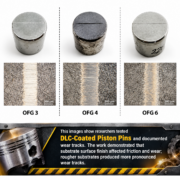
Potential Issues With DLC Coatings On Piston Pins
1. Coating de lamination
If the DLC doesn’t adhere properly to the underlying steel, sections can crack or peel away. Once the coating is damaged, the exposed substrate can wear considerably faster.
2. Incorrect coating thickness
The piston pin is a precision component. An excessive or poorly controlled coating thickness can affect the pin’s effective dimensions and the clearance between the pin, piston and connecting rod.
3. Poor surface preparation
DLC generally requires carefully prepared substrate surfaces. Contamination, inappropriate surface roughness or inadequate pretreatment can reduce adhesion and coating life.
4. Brittleness / cracking
DLC is extremely hard, but some DLC formulations can also be relatively brittle. Under severe cyclic loading, an inappropriate coating/substrate combination can develop cracks.
5. Lubrication compatibility
DLC can have excellent friction characteristics, but its performance depends on the particular DLC formulation and lubricant. The wrong oil/additive combination or inadequate lubrication can still produce wear.
6. Counterface wear
The DLC pin doesn’t operate in isolation. The piston-pin bore and connecting-rod small end are equally important. A very hard pin surface paired with an inappropriate or poorly finished mating surface can shift the wear problem to the other component.
7. Coating defects
Pinholes, inclusions, uneven deposition or inconsistent coating thickness can create localized areas of accelerated wear.
8. Coating-process variation
Two parts both described as “DLC coated” aren’t necessarily equivalent. DLC encompasses a family of carbon-based coatings with different compositions and properties. Deposition process, hardness, thickness, adhesion and surface finish matter.
Particularly important for a piston pin
The piston pin has to survive millions of load reversals while maintaining the correct clearance.
So the engineering question isn’t simply:
“Does it have DLC?”
It’s:
“What DLC coating was used, how was it applied, and was the complete piston-pin assembly engineered around it?”
For a performance 125–130cc engine, you need to know:
- Base pin material
- Pin hardness/heat treatment
- DLC type
- DLC thickness
- Coating hardness
- Adhesion specification
- Surface roughness
- Pin diameter tolerance
- Piston-pin clearance
- Connecting-rod small-end specification
- Recommended lubrication
“DLC performance is coating- and lubricant-dependent, so compatibility should be demonstrated rather than assumed.”
4. DLC introduces a coating-to-mating-surface issue
The piston pin doesn’t work by itself.
It interfaces with:
DLC pin → piston pin bore / connecting-rod small end → lubrication
The hardness and surface characteristics of DLC can change the behavior of the mating surface.
Some very hard DLC systems can have greater “attack ability” toward softer mating materials; this is why specialized DLC formulations have been developed for applications involving soft-metal counter faces.
One important point: A properly specified and applied DLC coating can reduce wear. Problems are more likely when the coating process, dimensions, mating surfaces or lubrication are poorly controlled.
A DLC coating can provide genuine friction and wear benefits, but those benefits depend on the specific coating formulation, substrate, deposition process, adhesion, mating materials and lubricant compatibility. Therefore, “DLC coated” alone does not establish superior piston-pin durability.
“The performance of a piston pin depends on its substrate material, heat treatment, geometry, surface hardness, fatigue strength and manufacturing tolerances. DLC is a surface treatment and does not by itself establish the structural strength of the underlying pin.”
Wild Boar Uses 9310 High Performance for our piston pin.
| Material | Typical role | High-RPM suitability | Key characteristic |
|---|---|---|---|
| 4130/4140 | Standard performance | Good | Strong, economical |
| 5115 | Performance/aftermarket | Good | Case-hardened, good wear |
| 9310 | High-performance | Excellent | Tough core + hard case |
| H13 tool steel | Premium racing | Excellent | High core hardness/strength |
| 300M | Extreme racing | Extreme | Very high strength/fatigue capability |
| M2 / specialty tool steels | Top-level competition | Extreme | Very high hardness/strength |
| Wild Boar 9310 | DLC piN COATING |
|---|---|
| High-tensile pin material | High-tensile substrate + DLC |
| No coating dependency | Coating adhesion matters |
| Steel heat treatment important | Steel + coating properties important |
| Surface finish important | Surface finish + DLC important |
| Lubrication important | Lubrication + DLC/oil compatibility important |
| Dimensional accuracy important | Dimensions + coating thickness important |
| N.o DLC wear-through mechanism | DLC wear/degradation must be considered |


